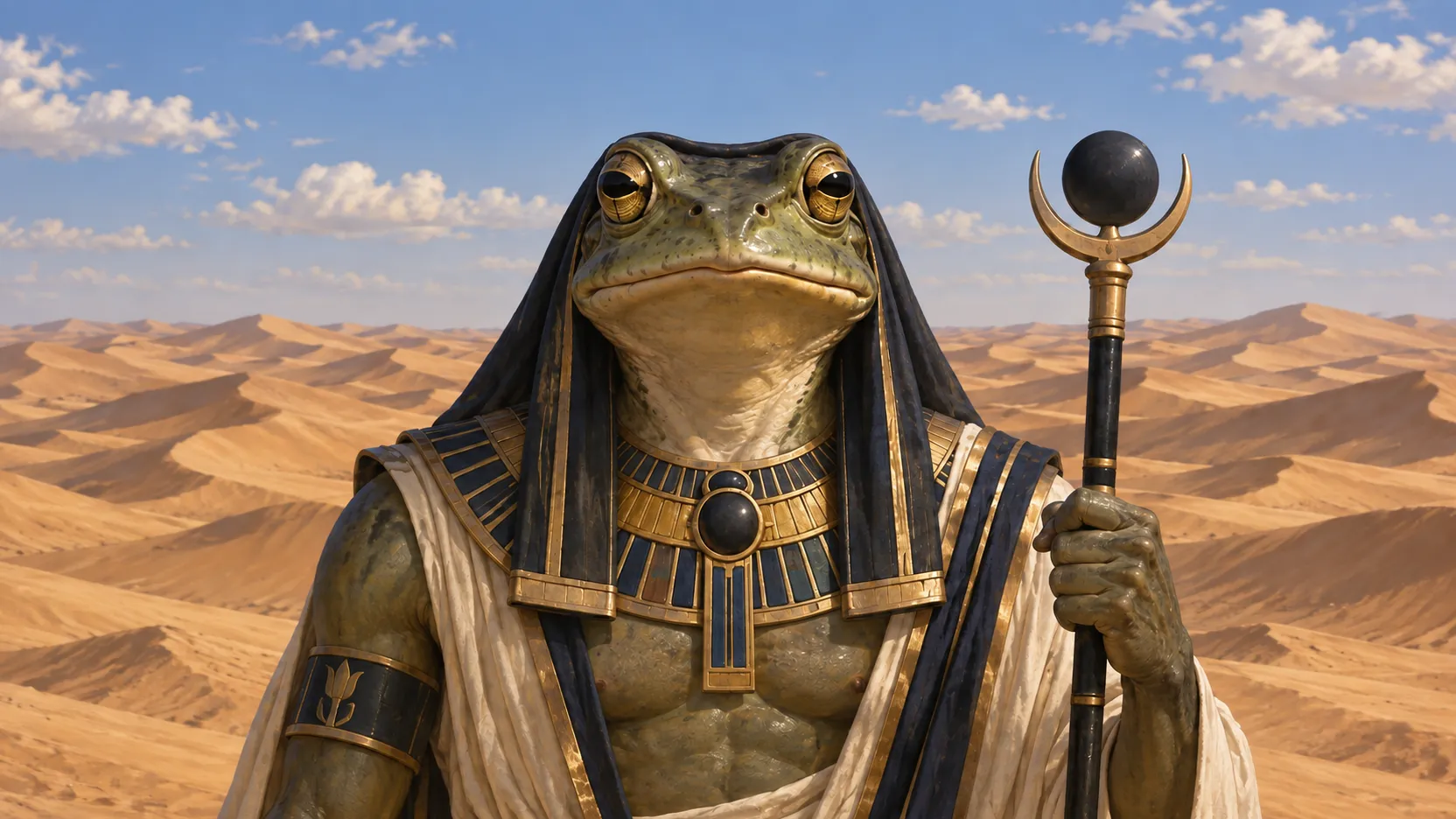
Something inside the egg struck back.
Kek held still. Beneath his palms, the shell had always been smooth, without a seam or a weakness. Now a ridge lifted against one finger. A grain broke loose. Warmth touched him through the hole.
Across the egg, Kauket tightened her grip.
“Did you do that?” she asked.
He had not. Nor had the six others whose weight he felt through the mound beneath them. They had brought this small piece of ground out of the water together. Until the knocking began, keeping it above the water had seemed work enough.
The shell struck his finger again.
Kek bent close. There was no sky yet, no horizon, nothing to separate the water from the darkness resting upon it. He knew Kauket by the pressure opposite his own. He had never needed to see her.
“Wait,” he told whatever was inside.
A line opened beneath his hands.
For the first time, Kek saw an edge.
It ran across Kauket’s knuckles, sharp and pale. On one side her hand lay against the shell. On the other it vanished into him. He recoiled from the division, and his darkness closed over the crack.
The warmth stopped.
Kauket tapped the shell. Once. Twice.
Nothing answered.
“Take your hand away.”
“It was breaking.”
“Something was breaking it.”
He lifted his palm. The darkness remained. It was in the opening, around the egg, under their knees; there was nowhere he could put it that was not already himself.
Kauket moved around the shell until her fingers found his wrist.
“Not your hand,” she said.
Kek listened for the knocking. He wanted it again with a fierceness that surprised him.
Slowly, he drew himself back from the hole.
Warmth pricked his skin. From deep inside the egg came a small, scraping movement.
“There,” Kauket whispered.
A voice spoke against his palm.
“Is there room?”
Kek felt the water worrying at the mound. The ground was barely wider than the two of them, soft enough that his knees had sunk into it.
He pressed them deeper.
“There will be.”
The Opening
Kauket found the loose edge of shell and worked a finger beneath it. Kek held the egg against the slope while she pulled. The fragment came free with a sound like a tooth snapping.
Light struck the mound.
Wet clay shone between them. The water beyond it flashed, and Kek saw how little they had made: a slick rise, a curved shell, two bodies crouching where a world ought to be.
The child inside the egg pushed harder.
“Not all at once,” Kek said.
He narrowed the opening with his darkness, leaving a passage no wider than Kauket’s finger. The pressure eased. For a moment the mound held.
Then the light touched its far side.
Water rushed down the newly visible slope. Clay slid after it. Kauket’s knee dropped, and the egg rolled toward her.
Kek caught it against his chest.
“Your hand.”
“I have the shell.”
“Give me your hand.”
“If I let go, it will close.”
He could see her now, one arm sunk to the elbow in the crumbling ground, the other holding the opening apart. That sight was worse than not knowing where she was. He saw the space he had to cross. He saw it growing.
Under the mound, the other six shifted. A great pressure rose through his knees, lifting the clay, but each place the light reached began to give way before it settled. The world was appearing faster than it could hold its shape.
Kek leaned over the egg and caught Kauket’s wrist.
The shell cut his forearm. A strip peeled away, and light poured between them.
Kauket slipped.
For one terrible instant her weight hung from his fingers. He dragged her toward him, pulling darkness across the opening as he pulled her across the clay. The water disappeared. The broken ground disappeared. Her body struck his, and the egg rested between their knees again.
He held her there.
The child made a muffled sound.
Kauket braced a hand against his chest.
“Let it breathe.”
“The ground won’t bear it.”
“Then we must hold the ground.”
“We were holding it.”
She was silent. He felt her turn her face toward the egg.
Inside, something scraped once, very softly.
Kek spread himself beneath the mound. He entered every hollow the water had opened, gathered the loose clay into darkness and held it against the pressure of the deep. Above, he kept the shell covered. He could do both. He could keep Kauket close and the ground whole and the child safe inside.
The scraping stopped.
“Kek.”
He knew the tone. He loosened his arms around her, but not the darkness around the egg.
“Listen,” she said.
He listened so intently that he felt the six beneath them, the water beyond them, the weight of her hand against his body.
There was no sound from the shell.
The Hand He Could Not Keep
Kauket took his hand and placed it over the broken opening.
“Ask it.”
He did not want to. He had told the child there would be room.
He bent until his mouth touched the shell.
“Are you hurt?”
After a long silence, the voice answered.
“I cannot get out.”
Kek drew back a little darkness. Heat returned beneath his fingers, weaker than before.
“Wait until the ground is ready.”
“How will you know?” Kauket asked.
He pressed his free hand into the clay. It spread between his fingers. Beyond the mound, there was no shore. There had never been a shore. Nothing in all he knew could tell him when a beginning was strong enough.
The egg stirred toward the opening.
Kek covered it again before he meant to.
Kauket caught his wrist.
They stayed like that, each feeling the other’s strength.
“If it comes out,” he said, “there will be places I cannot reach you.”
Her grip changed. She slid her fingers down until their palms met.
“You reached me when I fell.”
“I brought everything back.”
“Yes.”
She waited. The egg lay motionless against them.
Kek tried to imagine Kauket somewhere beyond him. He could imagine losing her; he had felt the beginning of it when the clay slipped. He could not imagine knowing she was there without holding the place where she stood.
“Call to me,” she said.
“You are here.”
“Call to me when I am not.”
She began to withdraw her hand.
He closed his fingers. She stopped, neither pulling harder nor returning the pressure. That was worse. He could have held her. She was letting him discover it.
Behind their hands, the child pressed once more against the shell.
Kek opened his fingers.
Kauket moved away. He felt her knees cross the clay, then the ground trembled as she took her place on the far side of the egg. He could have spread himself after her. He kept himself where he was.
“Kauket.”
“Here.”
Her voice came from a place.
He lowered his forehead to the egg. Beneath the shell was a heat he could no longer mistake for his own.
“I am going to move,” he told the child. “Push when you feel me go.”
The First Distance
Kek drew his darkness out of the crack.
Light entered the space Kauket had crossed. The clay shivered. Water spilled over the lip of the mound, and he wanted to cover it, to hide the loose edge until it could no longer fall.
Instead, he pressed down beneath it.
The six answered with their weight. The mound rose a little. Water drained from its sides.
Across the egg, Kauket drove both hands into the clay.
“Again,” she said.
Kek withdrew farther.
The opening widened. A small hand came through, closed on the edge of shell and broke it. Light ran up his arms. He saw his fingers, the wet places between them, the egg rocking toward him.
The child pushed, and the shell tipped.
Kek caught its lower edge. He could still close it. The thought came as an action, darkness gathering around the broken rim, and the little hand faltered.
He stopped.
Across the mound, Kauket’s face had become visible. She was straining against the sliding ground. She did not tell him what to do.
Kek set the egg down.
Then he eased himself from its hollow, leaving the warmth exposed. The rim broke under the child’s weight. One foot touched the clay, sank, and lifted again.
Kek put his palm beneath it.
The child stepped onto him.
Heat pierced his hand. Darkness thinned along his wrist, and beyond it the mound spread into view: ridges, hollows, running water, the marks of Kauket’s knees. The things he had held together were becoming different things.
He lowered his hand until the child’s foot found ground.
This time the clay held.
The child took another step. Light rose with him, lifting beyond the mound, and Kek felt himself drawn back under the broken shell, beneath the clay, into the places the brightness did not enter. For a moment he could not find Kauket at all.
He called her name.
“Here.”
He turned toward the voice.
She stood on the other side of the mound. Water ran from her arms. Between them, the child was looking outward, discovering how far a gaze could go.
Kauket walked around him. Her feet left separate prints in the wet clay. When she reached Kek, she crouched beside the broken egg, where its curve made a small darkness of its own.
Her fingers found his.
They no longer met everywhere. He felt each place they touched.
Above them, the child shifted, and the shadow moved across the clay. Kek followed it to the edge of the shell. His hand lay across the child’s next footprint.
He lifted it.