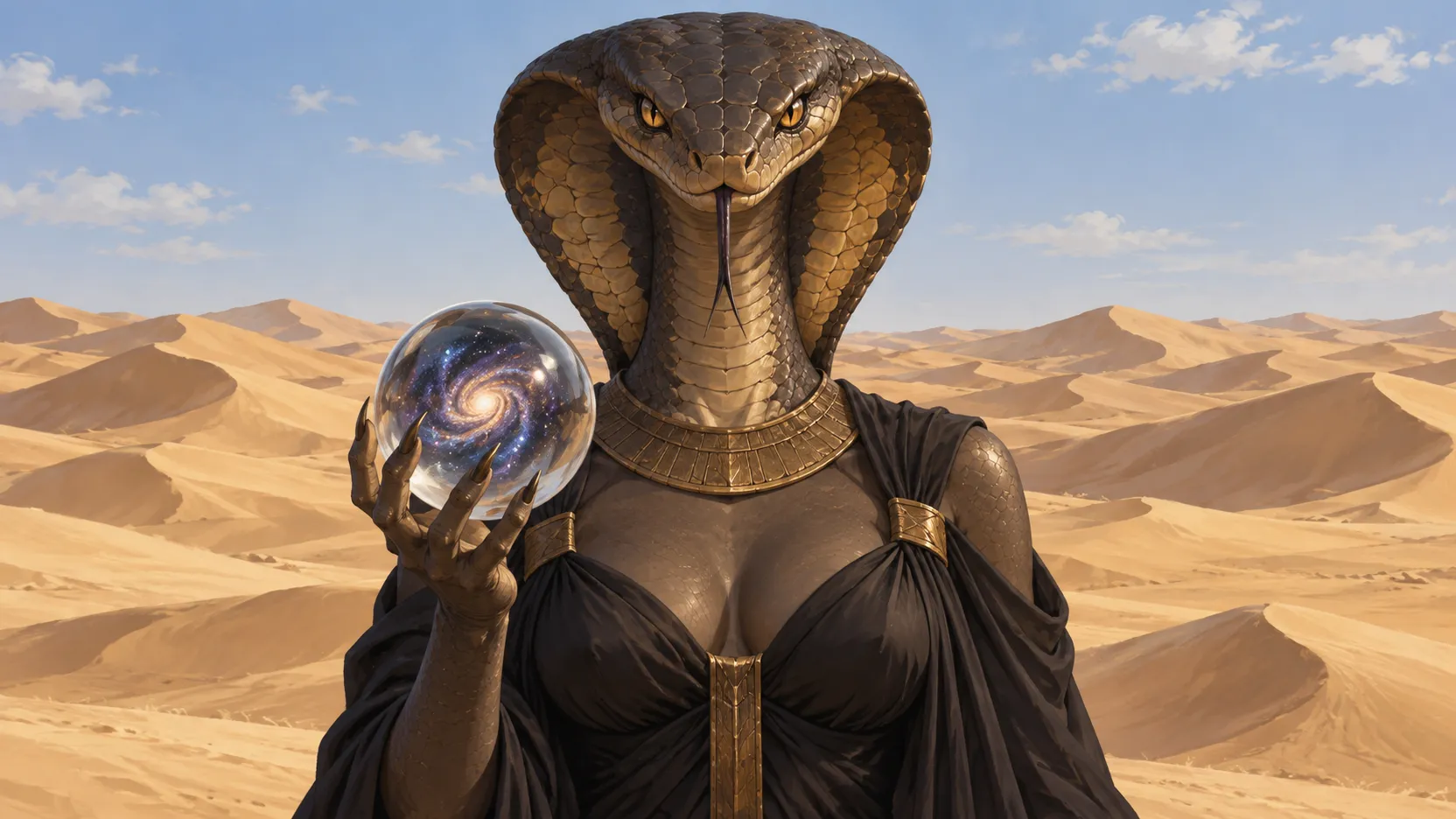
The bird fell into Kauket’s hands while the sun was still refusing to move.
It had tried to reach a nest in the reeds. Three times she had watched it climb, wings beating crookedly against the white sky; three times it had struck the stems and tumbled. Now its feet closed on her finger with scarcely enough strength to hold. Through its open beak came a dry, quick clicking.
Above the nest, its mother called.
Kauket put her other hand over the small head. Darkness gathered between her palms. The clicking stopped. She felt the bird settle against her skin, and for a moment she thought the work was simple.
Then the reed beneath her elbow disappeared.
It did not break. There was no splash, no torn fiber against her arm. Where its stem had stood, her darkness lay smooth and without interruption.
She opened her hands.
Light struck the bird. It flung itself against her fingers, fighting to fly again. Beside her, the riverbank ended in a wet hollow where a clump of reeds had been.
“Come back,” Kek said.
His voice reached her from beneath the bank, where the sun had not yet found every fold of earth.
Kauket held the bird away from that hollow.
“It needs to be still.”
“Then bring it here.”
She knew what he offered. Before the Eight had brought forth the sun, there had been no distance between his voice and hers. Nothing had needed to cross the darkness to reach anything else. She had never lost a thing. There had been no separate things to lose.
The bird’s claws tightened.
She could not take it back there.
The Edge of the Light
Kauket walked along the bank with the bird cupped against her breast. Light followed every bend. There were pools beside the river where small fish crowded beneath leaves, but the leaves were curling, and the fish kept turning their bright sides upward. No creature had yet learned when to stop moving. The sun had climbed, and climbed, and stayed.
At the end of the bank, the river broadened into the waters from which the land had risen. Kek stood where those waters lost their shine.
“You made a hole,” he said.
“I saw.”
“There is no ground where we are.”
“There is ground here.”
He extended his hand. She shifted the bird and took it.
For an instant the glare ceased to trouble her. The pressure of his fingers was familiar; the coolness beyond him had no shore. She could let go of the bird, of the bank, of the reed she had destroyed. The sun could keep its hard little world.
Then something sharp pricked her wrist.
The bird had found a loose thread and was pulling at it, trying to build itself a place to cling.
Kauket looked down. One wing hung lower than the other. She tucked the thread beneath its feet.
“If I cover the land,” she said, “will you help me keep it?”
“Keep what?”
She could not answer him in words he would recognize. Instead she placed his finger against the bird’s breast.
Its heart beat against them both.
Kek drew his hand back slowly.
“It will stop,” he said.
“Not yet.”
She left him at the water and stepped onto the last ridge of bare earth. Ahead, the sun hung so low that she could see a figure within its brightness, standing with his feet apart as though braced against a door.
He saw her coming. The light sharpened.
What the Sun Could Not See
“Stay there,” the sun said.
Kauket stopped. Hot dust pressed between her toes. Behind her, the bird’s mother circled the river, still calling to a nest that had been empty too long.
“You have been looking at the world,” Kauket said. “Look at this.”
She opened her hands enough to show him the bird.
“It has wings.”
“It has used them.”
“Then let it fly.”
She lowered her hands. The bird tried. One wing beat her wrist; the other dragged. She caught it before it struck the ground.
The sun’s brightness flickered.
“Give it water.”
“I have. It needs something you cannot give while you stand there.”
He looked past her to the riverbank. His gaze found the hollow.
“You would put that over everything.”
The accusation struck cleanly. Kauket could feel the missing reed as a smoothness in herself, a place where there should have been resistance.
“I do not want another hole.”
“But you made one.”
“Yes.”
The sun shifted his feet, and shadows moved beneath the stones. He caught the movement and stiffened. At once the shadows stopped.
“What happens to them when I cannot see them?” he asked.
Kauket glanced at the bird. Its eyes were closing despite the glare. Each time they shut, its whole body jerked them open again.
She had no promise she could safely make. In the old darkness, the sun’s fear was true.
“Move as far as that stone,” she said.
“Why?”
“Because I can stand between it and the water.”
“And if the stone is gone?”
“Come back.”
For a long time he did not move. Then he took one step downward.
Darkness passed over the ridge.
Kauket felt the stone before she saw it vanish from sight: its sharp upper edge, its buried weight, the narrow space beneath where an insect had wedged itself. She put her foot against it. The bird lay in one hand; she set the other on the earth.
Water touched her heel.
It was not the river rising. The ridge was losing its height. The dark had found the seam between earth and water and was smoothing it away.
The sun lifted himself.
“Wait.”
Kauket drove her fingers into the ground.
Mud forced itself beneath her nails. A root caught around her wrist. She had never needed to hold anything in place before. She pressed down on the stone until its edge hurt her foot.
Here was the stone. Here was the root. Here was the small heart, beating too fast.
The water stopped at her ankle.
“Again,” she said.
The First Night
The sun descended another step, and Kauket spread across the bank.
Everywhere she touched, the old ease called to her. Let the stones soften into the water. Let the water lose its shores. Let all those separate, struggling hearts become quiet together.
She held the nearest root. Farther along the bank she found another, then the tangled feet of the reeds. She let darkness fill the spaces between them, feeling where each stem resisted. Behind her, the river ran unseen within its banks.
The bird gave one last shudder and went limp.
Kauket nearly opened her hand to the light.
Then she felt its breast rise.
It rose again, more slowly.
“Keep going,” she told the sun.
His face was almost below the ridge now.
“How will I know when to return?”
She wanted to tell him not to. Across the river, the first bank of sleeping reeds stood intact inside her. She had given the bird what it needed. She could gather the world to herself and learn the shape of every living thing. She could keep it all safe, all still.
The bird’s claws loosened. One toe slipped from the thread.
It would need to wake. It would need the nest, the sky, the effort of those unfinished wings.
“When you come back,” she said, “I will make room.”
The last light withdrew.
Kauket felt Kek on the far side of the water. She reached for him, and her darkness surged across the river. The bank beneath her hand began to soften again.
She stopped reaching.
Between them remained the breadth of the river, its current, its two distinct shores.
“Kek.”
His answer came across a distance.
“I am here.”
She listened until the words reached her. Then she set the sleeping bird beside the stone and curved her hand around it.
Throughout the dark, the river kept moving.
When light returned, it first touched the highest reed. Kauket felt each stem emerge from her keeping. The stone warmed beneath her foot. The bird stirred, opened its beak, and this time made a small, demanding sound.
Its mother answered.
Kauket carried it to the reeds. She lifted her hand until its claws found the rim of the nest. The bird gripped, stumbled forward, and vanished beneath a spread of feathers.
Behind her, sunlight reached the place where she had been standing.
She moved into the narrow shade of the bank. From beyond the bend, where the river still ran dark, Kek called her name.