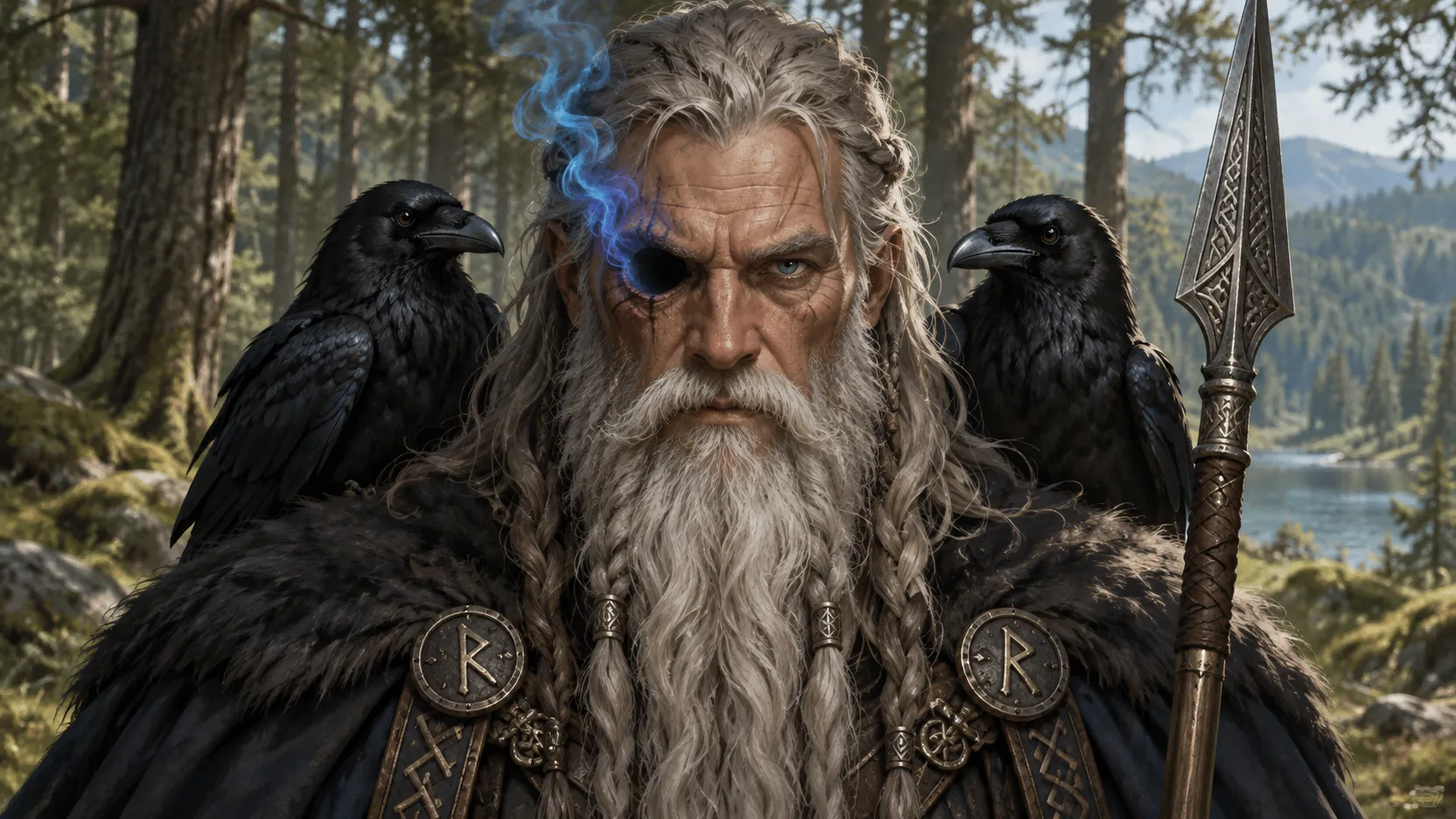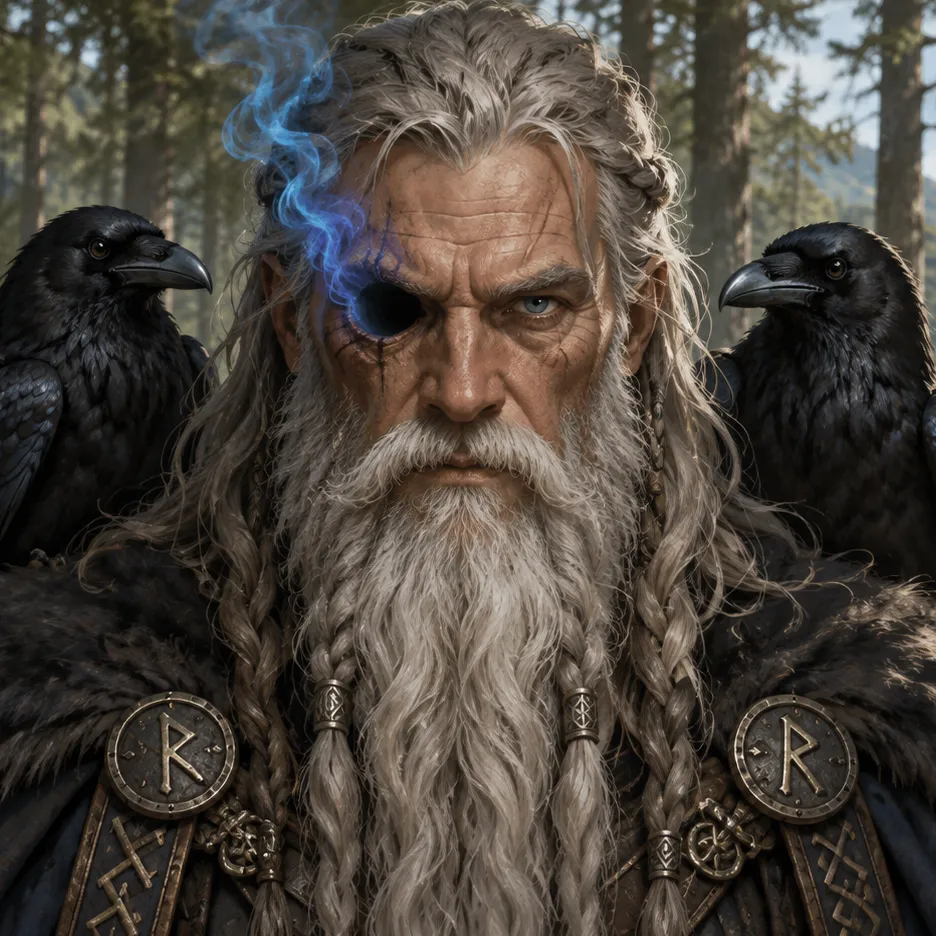
The door-bar dropped behind Odin before he had taken three steps into the hall.
He did not turn. Snow melted from his cloak onto the beaten earth, and the man at the far end of the fire watched the drops fall. Vafthrudnir sat beneath a roof beam thick enough to have been a living tree in a younger world. His bare feet rested on a stone. Beside one heel lay a long knife, clean except for a dark seam where blade met handle.
“You have come a long way,” the giant said.
“For a drink, if your household can spare one.”
“And a name?”
“Gagnrad.”
Odin kept the brim of his hat low. His spear, wrapped at the head, served him as a walking staff. He had left the ravens beyond the ridge. There were houses into which even a god should enter without announcing himself.
Vafthrudnir looked at the staff, then at the water gathering around the stranger’s boots.
“What else have you come for, Gagnrad?”
“To discover whether you know as much as people say.”
The giant moved his foot off the stone.
“Then you will discover it here. You leave when you have proved yourself wiser.”
Odin heard Frigg again, as he had heard her before setting out: stay among your own. She had not caught his sleeve or stood across the door. She knew that forbidding the journey would only give him another obstacle to enjoy.
Instead she had asked him what answer could be worth the risk.
He had told her he would know when he heard it.
Now, with the bar down and the knife within his host’s reach, he wondered whether she had recognized that for an evasion.
Vafthrudnir indicated a bench.
Odin remained standing. From the bench, the giant could reach his throat without rising.
“I have not yet earned your hospitality.”
“Earn it, then. What carries the day across the world?”
“Skinfaxi. The horse with the bright mane.”
“And the night?”
“Hrimfaxi. The dew falls from his bit.”
The giant’s gaze sharpened. He asked for the river dividing the lands of gods and giants. Odin gave him Ifing, and added that its current never wore a skin of ice.
He could have stopped at the name. The addition escaped him because he remembered the crossing: black water forcing its way between the rocks, a bank that would not come nearer, the sudden loss of the riverbed under his foot. Vafthrudnir heard something in his voice and leaned forward.
“One more. Name the ground on which Surt will meet the gods.”
The fire shifted in a draft. Odin looked at the giant’s hands.
He had sent men into battle whose fingers trembled before they closed on a weapon. Vafthrudnir’s did not tremble. They waited, open on his knees.
“Vigrid,” Odin said.
“How wide?”
He gave the measure. As he spoke it, the hall seemed miserably small: one fire, two benches, a knife. Out on that field there would be room for every warrior he had gathered, and still room for the wolf.
Vafthrudnir drew the knife from beside his heel and laid it across the hearthstone between them.
“Take the bench. We shall put more than a drink between your wisdom and mine.”
“What do you propose?”
“Our heads.”
Odin lowered himself onto the bench.
The Giant’s Memory
The cup was made for the giant’s hand. Odin lifted it with both of his and drank. The water was cold enough to hurt his teeth.
Across the fire, Vafthrudnir settled back. He had tested his visitor and found someone worth killing. That made him almost generous.
“Ask.”
Odin began with the earth.
He asked what it had been before there were roads across it, before men cut fields out of the forests. The giant answered with Ymir’s flesh. Mountains had been bone; the sea had been blood. Above them stretched the inside of a skull.
Vafthrudnir tapped the hearthstone with a thick nail.
“You warm your feet on what remains of him.”
Odin rested the cup on his knee. He remembered the work of making the world, the weight of it, the vast resistance before its parts took their appointed places. He had expected a recitation. The giant spoke as though a member of his household had been butchered and the guest was admiring the furniture.
“What is the earliest thing you remember?” Odin asked.
“Bergelmir being borne away.”
The answer came without hesitation. Then, for the first time, Vafthrudnir looked past his guest. His fingers folded slowly into his palm.
Odin watched him. Here was a memory from before the human voices he had collected, before the kingdoms whose borders his ravens followed each morning. He wanted the giant to go on. He wanted the sound, the shape, the smallest detail that might reveal how something had survived the ruin of a world.
“How was he carried?”
“You asked what I remembered.”
“And now I ask more.”
“Of course you do.”
Vafthrudnir reached for the water jug and filled his own cup. He did not offer the jug across.
Odin changed his line of attack. He asked about the wind that moved unseen over the sea, and the giant placed its source at the edge of heaven, beneath an eagle’s wings. He asked about the old dealings between the gods, and the answer returned complete. He approached the same knowledge from another direction, seeking a disagreement, a name put in the wrong place.
Nothing opened.
His host was not repeating things heard at a feast. He possessed them. Each answer left Odin with more knowledge and less room to win.
A log broke across the fire. Sparks struck the giant’s foot. He brushed them away without looking down.
“Who fights every day,” Odin asked, “and sits whole again when the fighting is done?”
“The warriors in Odin’s hall.”
Vafthrudnir studied the dark space beneath the hat brim.
“A useful army. No burial. No empty place at supper.”
Odin put the cup down before his grip cracked it.
The giant saw the movement.
“Does that trouble you, Gagnrad?”
“I am wondering whether you have seen what you describe.”
“I have traveled where the dead go. Farther down than a man would go for a drink.”
“Then you can tell me what follows.”
“Follows what?”
Odin could have asked another question about the beginning. He knew a hundred difficult ones. He could spend the fire down to ash on the fathers of rivers and the ancestry of frost, searching for a mistake that would give him the giant’s head.
He had not crossed Ifing for a head.
“The winter,” he said. “The one that does not release the earth.”
The Name of the Wolf
Vafthrudnir stopped smiling.
“What would you know?”
“Who lives through it?”
Two names came across the fire: Lif and Lifthrasir. The giant spoke of their hiding place in Hoddmimir’s wood and the morning dew that would sustain them.
Odin held the names apart in his mind, carefully, as a man might shelter two small flames. He had expected the answer to begin with a fortress, an army, a god strong enough to hold a gate. Instead it began with two people hidden among trees.
“And light?” he asked. “When the sun is gone, what warms their children?”
“The sun bears a daughter before she is taken. The daughter follows her mother’s course.”
Vafthrudnir watched him receive that answer.
“You ask very tender questions for a man wagering his head.”
“Perhaps I have children.”
“Then ask about them.”
The offer struck too close. Odin felt, absurdly, the heat of another fire against his face. For a moment he saw the pale ear of his son, close enough to touch with his lips. He shut the memory away before it could take the next word from him.
“Which gods remain after Surt’s fire?”
“Vidar. Vali. And Thor’s sons have his hammer.”
Vafthrudnir named what would endure with the same composure he had used for the horses of day and night. Odin waited for another name. The giant lifted his cup.
“That is your answer?”
“Would you like a different one?”
Odin’s hand found the shaft of the spear beside his knee. The wrapping hid the head, but he knew precisely where its point lay. One movement would put it into Vafthrudnir’s throat.
The giant glanced at the hand.
“You can still ask.”
Odin let go.
He had bought knowledge with an eye. He had hung hungry in the wind until the runes yielded. He had endured worse things than an old giant watching him hesitate. Yet the words he needed were difficult to shape without begging.
“What kills Odin?”
Vafthrudnir set down his cup.
“The wolf.”
The fire gave a soft, settling sound.
“His son avenges him,” the giant continued. “Vidar tears the jaws apart.”
Odin looked at the knife on the hearthstone. He could count the nicks in its cutting edge. He could hear the water dripping from his cloak, slower now, and somewhere high in the roof the scratching of a small animal.
He had known the wolf was waiting. He had come seeking a gap in what he knew: another ending, an overlooked weapon, a condition hidden inside the prophecy. Vafthrudnir had given him a son standing over a dead enemy. He had not given him a father who survived to see it.
“After,” Odin said.
“Yes.”
The giant leaned across the fire.
“You did not ask who would avenge him.”
“No.”
“What a hungry man you are, Gagnrad.”
Vafthrudnir’s eyes moved once more toward the wrapped spear. The amusement had left him. He was assembling the stranger from the things that hurt him.
Odin knew that expression. He had worn it himself while a king talked too freely, while a frightened man tried to invent a name, while an enemy realized too late which question had betrayed him.
The giant reached down and turned the knife so its handle lay toward his own bench.
“Ask your last question.”
What the Father Said
There was one answer Vafthrudnir could not possess.
Odin had carried it into the hall without intending to use it. He had kept it apart from the runes, from the reports brought by ravens, from the secrets drawn out of graves. No army had been raised upon it. No bargain had spent it.
His son had been cold beneath his mouth.
The fire in this hall pressed against his face, and for an instant the two fires were one. He remembered leaning close so that no other mourner would hear. Remembered the terrible stillness of the ear that had once turned toward his voice.
Across from him, Vafthrudnir waited with his hands clear of the knife. He would win without reaching for it if he could. Odin almost admired him for that.
“Have you finished?” the giant asked.
Odin raised his head.
“Before Baldr was given to the fire, what did his father whisper in his ear?”
Vafthrudnir drew breath.
He held it. His gaze fixed on the shadowed face, then dropped to the spear. The wood of the bench creaked beneath his shifting weight.
Odin did not help him. He sat with the question between them and waited for the giant to find the boundary of everything he knew.
At last Vafthrudnir let the breath go.
“You.”
The small word carried farther through the hall than any of his answers.
He looked toward the barred door, though it was not he who had been trying to leave. Then he pushed the knife across the hearthstone. Its point scraped a white line through the ash.
“Only you know that.”
Odin rose. His legs were stiff from the bench, and he took a moment to settle his weight before lifting the spear. The wrapping slid from its head.
Vafthrudnir did not move away.
“What were the words?” he asked.
Even now. Even with the point bare.
Odin looked at the giant, and understood how long they might have sat together if neither had needed to win.
He took up the knife instead. Vafthrudnir raised his chin.
But Odin laid it on the vacated bench.
“Keep your head. I may have another question.”
The giant’s jaw tightened. He had offered his life and received a debt. For a moment it seemed he would refuse it. Then he rose, crossed the hall, and lifted the bar.
Outside, the snow had stopped. Huginn came first, dropping from the roof to Odin’s shoulder. Muninn followed and settled on the other side, his claws finding their familiar purchase through the cloak.
Odin stood on the threshold until both birds were still.
“Lif,” he told them. “Lifthrasir.”
He spoke each name again. Muninn bent his head close to listen.
Behind him, Vafthrudnir remained in the doorway. Ahead lay the descent to the river, and beyond the river the long road home. Odin lifted Gungnir from the snow and sent the ravens out before him, carrying the two names into the morning.