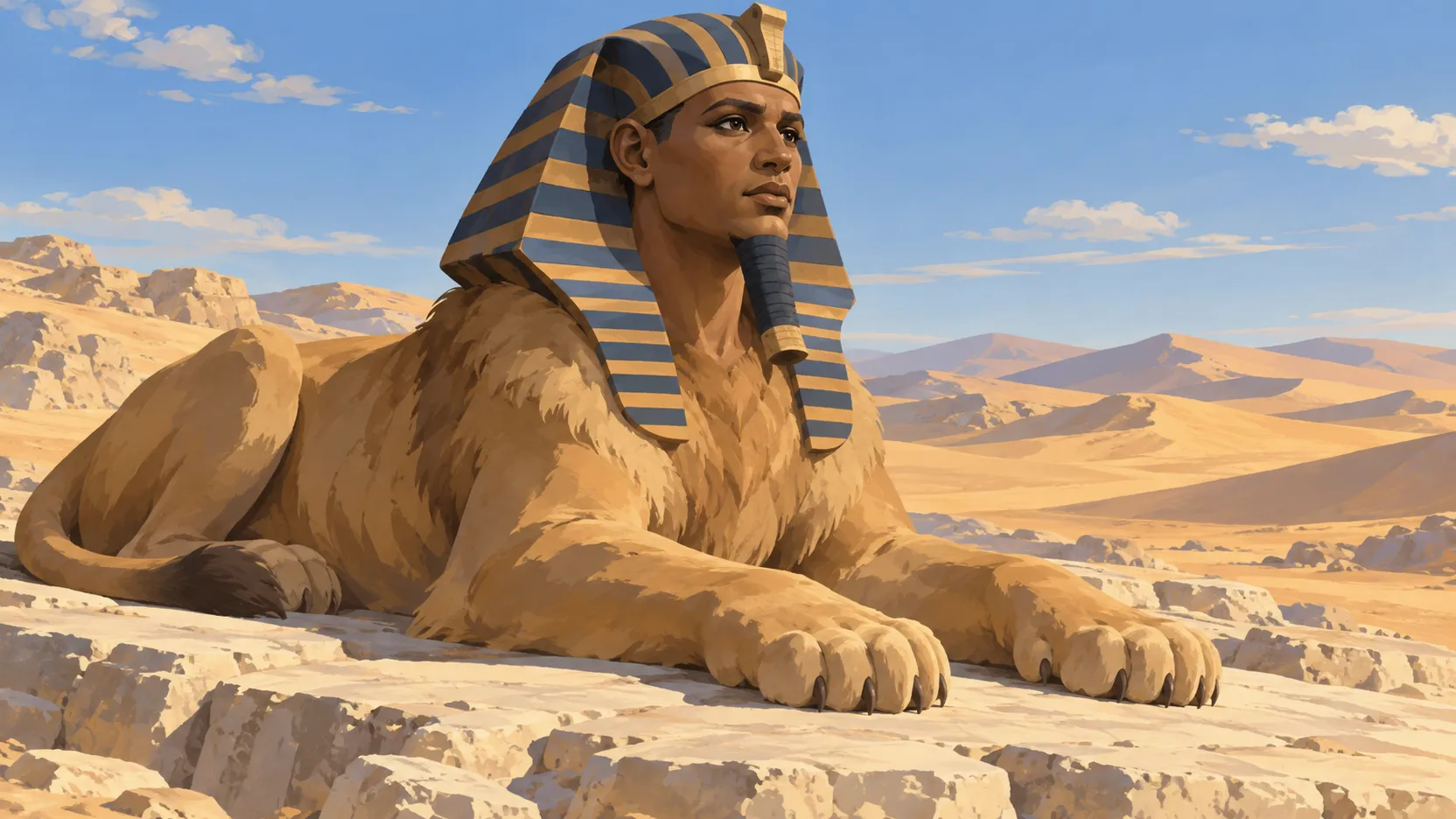
Sand was running out of the wall behind the boy’s heels.
Tia caught his basket before he could tip it over the edge. The load dragged at her shoulder. Below them, men worked in a trench beside the Sphinx’s buried foreleg, their heads scarcely higher than her feet.
“Not there.” She turned him toward the hauling path. “Take it up.”
“The overseer said here.”
“The overseer isn’t underneath.”
The boy scowled, but he took the basket. As he climbed, a little fan of sand slid into the print his heel had left. Tia watched until it stopped.
She had carried forty-seven loads since dawn. Fifty earned the day’s grain; sixty earned the copper the prince had promised for work completed before noon. With that copper she could put her father on the evening boat. Without it, he would have to walk home on the foot that no longer bent.
Above the excavation, the Sphinx looked past them all.
His human face rose from the sand in the stiff folds of a royal headcloth. Yesterday Tia had thought him all head. Now a stretch of chest had emerged, and the swelling stone of a lion’s shoulder, larger than the boat she wanted to hire. Somewhere under her feet, the foreleg continued.
She pushed her digging board down beside the exposed stone. It struck something solid sooner than she expected. She scraped away a palmful of sand. A rounded ridge appeared, then a second.
Toes.
The paw ran beneath the ledge where they were carrying the baskets.
Tia called the overseer. He came down sideways, keeping his clean linen clear of the trench.
“We have to cut the bank back,” she said. “The paw goes under it. They’re digging a hollow beneath the path.”
He looked at the small patch she had uncovered, then up at the bright canopy on the rim. The prince stood beneath it, watching a servant arrange a chair.
“Show him that,” the overseer said.
Tia thought he meant the dangerous bank.
“The claw. Brush it clean.”
The Promise
The prince came down with two attendants and the particular care of a man who wished not to appear careful. His sandals slipped once. Tia held out her digging board; he caught it, recovered, and gave it back without looking at her.
“You have found the foot.”
“Part of it.”
“How much more until it is free?”
“If we widen the cutting, tomorrow.”
“And if you keep working?”
She pointed to the ledge. The basket boy was crossing it again, arms lifted for balance.
“We are working.”
The overseer made a sharp noise in his throat.
The prince crouched by the two exposed toes. Even crouching, he could not have encircled one with both arms. He laid his palm on the stone, then glanced upward at the immense royal face.
“He spoke to me,” he said.
Tia waited.
“In a dream. He asked me to free him.”
She had heard the men discussing it before dawn. There would be witnesses by noon, priests and men from the palace. The prince meant to meet them standing between the cleared paws.
“Then he can wait until tomorrow,” she said.
This time the overseer seized her wrist.
The prince stood. “Sixty loads. Double the copper. Every carrier who stays until the feet are clear.”
He was looking at her when he said it.
Double would buy the boat and grain for the journey. Her father could eat without pretending he had eaten already.
Tia pulled her wrist free. She picked up her basket.
For the next hour she carried the loads all the way up the hauling path, though the overseer shouted that she was wasting steps. Twice she stopped other carriers from tipping sand over the ledge. On the third trip the boy stuck out his tongue at her, but went the long way without being told.
When the water jar arrived, she sat in the narrow shadow of the Sphinx’s chin. She meant only to drink. Her hands were trembling too much to lift the cup cleanly, and she rested them on her knees until they steadied.
A breath warmed the back of her neck.
The shadow had widened.
She turned. Sand poured down a tawny chest in fine streams. Above it the great human face inclined toward her, bringing the folded headcloth through the air with the sound of a sail filling. Beneath the smooth royal cheeks, a lion’s throat worked. His eyes held hers without the restless little movements of human eyes.
She could see one forepaw now. It lay along the trench, its claws sheathed, its weight pressing the sand into hard ridges. The other was still buried.
“They’re digging,” she said.
The Sphinx drew breath. His ribs pressed against the earth, and the earth held him.
“Will you come back?”
His voice was low enough that she felt it through the soles of her feet.
“I’m going home.”
He waited. She heard a grain of sand strike the rim of her cup.
“What would you give me?” she asked.
The human eyes remained on hers. Behind him, she saw the entire buried length of the lion stretching away beneath the workmen and their paths, a body made for strength, unable to make room for a breath.
She wanted him to promise. She wanted something she could carry to the boatman.
Someone kicked her basket.
“Are you paid to sleep?”
The overseer stood over her. The chest was stone again. Her cup had fallen sideways, and the sand beneath it was dark.
Under the Paw
By noon she had carried sixty loads. The copper lay in a knot at the corner of her cloth. Not the double payment; that would come when the work was finished. She had decided she could live without it.
She was halfway up the hauling path when the bank broke.
There was no great crash. A soft rushing sound came from below, followed by a basket bouncing down the slope. Then a man shouted for everyone to stop moving.
Tia looked back.
The ledge was gone. Sand had filled the trench to the shoulder of the man nearest her. Another worker was dragging him out by his arms. Beyond them, where the path had crossed the buried paw, a small hand opened and closed against the stone.
The boy’s face was below it.
He had fallen into the space beside the foreleg. A slab of packed sand leaned over him, held up at one end by the paw. His chin was above the loose drift. Each time he struggled, more sand trickled over his shoulder.
Tia set down her basket.
“Stay still,” she called.
“I can’t get my foot out.”
“Look at me. Don’t pull it yet.”
The prince had come to the edge. An attendant caught his sleeve before he stepped onto the broken ground.
“Ropes,” Tia said.
Someone brought a hauling rope. She knotted it around her waist, but when she drew the loose end toward the boy she saw what would happen. They would pull him upward against the lip of the paw. His trapped leg would take the strain.
She needed to lift him across the stone, not out through the fallen bank.
Above her, the prince’s canopy snapped in a small breeze.
She scrambled up the path and reached for its hanging edge.
“Leave that,” an attendant said.
“Give me your knife.”
He put a hand over the knife at his belt.
Tia seized the cloth with both hands and braced a foot against the pole. The first pull only stretched it. On the second, a seam tore with a long, ugly sound. The canopy sagged. She pulled again, and sunlight fell across the empty royal chair.
The attendant caught her arm.
Below them the boy screamed once.
She looked at the prince. He was staring at the torn cloth.
“The knife,” she said again.
He drew his own.
What the Guardian Held
They tied the folded canopy to two ropes. Tia went down with one end over her shoulder, placing her feet on exposed stone wherever she could. The lion’s foreleg gave her a narrow way across the unstable cutting. She lowered herself along it until her knees rested on the paw.
The boy had stopped crying. That frightened her more.
“What’s your name?”
“Pentu.”
“You should have told me before you stuck your tongue out.”
He tried to smile. Sand slid from the shelf above his head.
She pushed the cloth down between his back and the stone. He could move one arm; together they worked the fabric under it, then under the other. When she tugged the lower edge, he cried out.
“Foot,” he gasped.
She flattened herself against the paw and reached into the sand beside him. Her fingers found his shin. Lower down, the foot was wedged sideways between stone and packed earth.
The hauling ropes tightened. Pentu’s mouth opened.
“Slack!” she shouted.
The ropes fell loose. She dug with her fingers, bringing out handfuls that spilled over her own forearm. The bank gave a tiny settling sigh.
From the rim, the overseer told her to come out.
Tia could see the hauling path beyond his legs. Her basket stood where she had left it. She could be on that path in a dozen steps.
Pentu’s fingers closed around her thumb.
She pressed her cheek to the hot stone and reached deeper.
His heel came free. She eased the foot straight, then tucked the cloth beneath his knees.
“Across the paw,” she called. “Slowly. Keep him off the edge.”
The ropes drew taut, but the sling pulled crooked. One side rose while the other sagged. Pentu slid toward the torn seam.
Tia caught him against her chest. Pain went through her shoulder. Above, one of the men had lost his footing in loose sand; the other was trying to hold both ropes.
“Another hand!”
The prince stood two paces behind them.
Tia could not bow. She could scarcely breathe.
“Here,” she said, and jerked her chin at the empty place on the rope.
He stepped forward. His sandal skidded, and he kicked both sandals away. He took the rope below the worker’s hands.
“Now?”
“On your knees. Pull toward you.”
He knelt.
The sling rose level. Tia pushed Pentu’s hips over the rounded toe while the men drew him across. For a moment his weight hung on her bad shoulder. Then it was gone. He lay on top of the paw, coughing sand onto the stone.
The shelf behind him folded inward.
Tia flung herself flat beside the boy. Sand struck her back and buried her calves. The rope at her waist tightened. She held Pentu against the paw until the sliding stopped, and the huge stone foot remained beneath them, warm and solid.
No voice spoke.
She could hear the prince breathing at the other end of the rope.
By the time they brought Pentu onto firm ground, the men from the palace had arrived. They found the canopy cut apart, the chair uncovered, and the prince on his knees with blood on one palm.
He looked toward them. Tia watched him recognize the sight he made.
Then he turned to the overseer.
“Cut the bank back.”
“It will take until tomorrow.”
The prince bent and picked up Tia’s digging board.
“Then bring water.”
Pentu would not let go of her hand until a woman came running down the path and called his name. Tia helped wrap him in the ruined canopy. Its fine border disappeared around his dusty feet.
At the pay table, the overseer counted out the second payment. He did not look at her. She checked it twice before tying it beside the first.
Her father was waiting by the road with his swollen foot stretched into the shade. She put his arm across her shoulders and helped him stand.
“We’ll catch it,” she said.
Behind them, the digging board scraped over stone. The prince’s sandals stood abandoned at the edge of the cutting, slowly filling with sand.