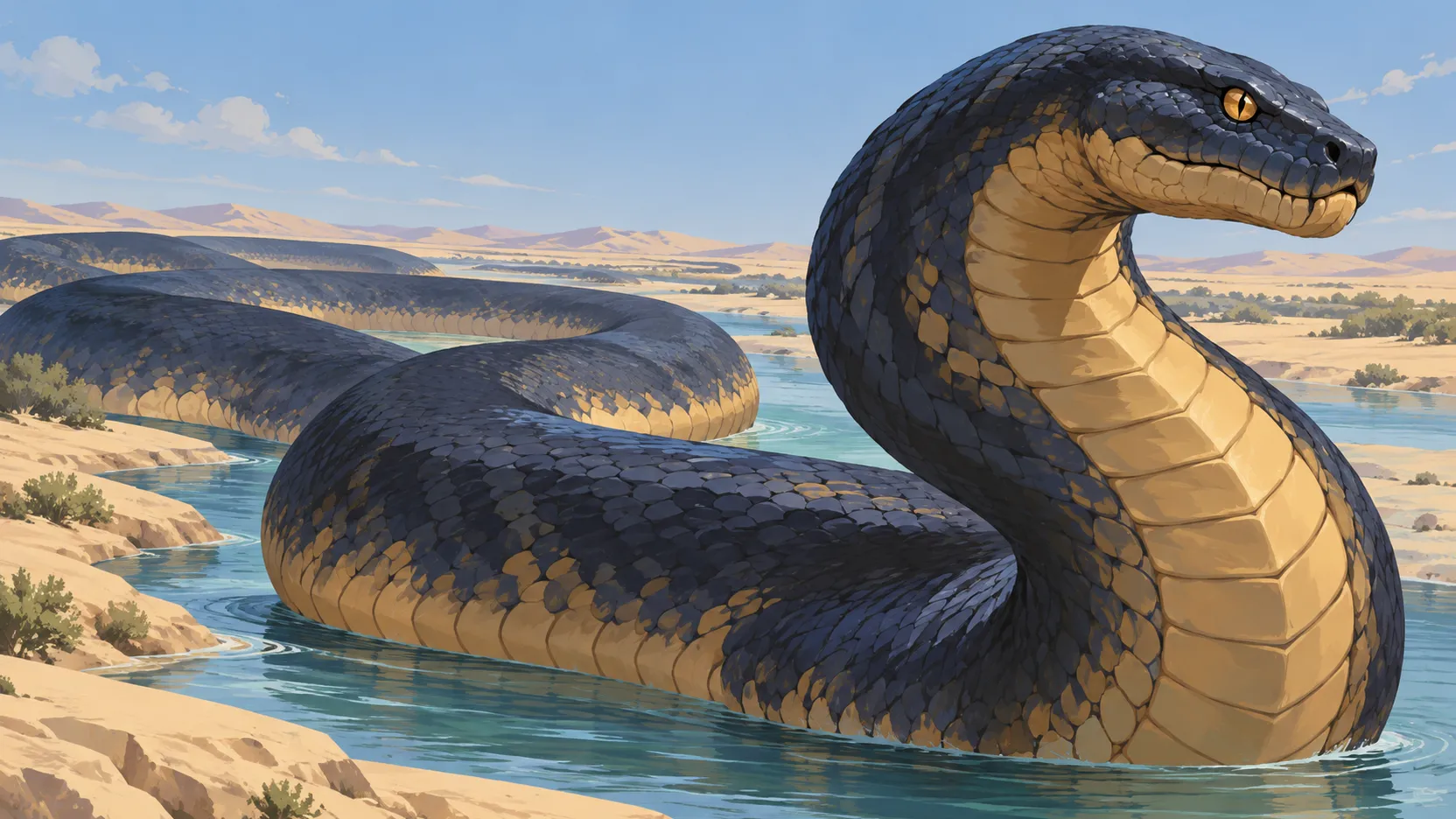
The river left the boat before anyone could lift an oar.
Serket watched it climb the bank in a shining sheet. Water ran uphill over sand, carrying the boat’s reflection with it. For an instant she could see two golden prows: one beneath her feet, one sliding away into the dark.
Then the second prow folded and disappeared.
The hull struck bottom. Iru, who had been coiling the towline beside her, fell against the rail. Beyond him the company of Ra staggered around the shrine, their shadows jumping in the light of the god within.
“Hold your places,” Serket said.
A sucking noise answered from ahead. The last water dragged through the stones beneath them. Where the river had curved out of sight, a pale bank rose, glistening, and rose again.
It was the underside of a jaw.
Apep lay across the channel with his mouth open. Between the jaws there was no glint of the water he had taken. The light from the barque reached his lower lip and went no farther.
Iru got up with the towline in both hands.
“How far?” he asked.
Serket knew what he meant. How far would they have to drag the boat before it floated again?
She looked along the emptied channel. Wet stones shone as far as Ra’s light could reach. There would be no dawn while the barque lay here.
“Leave that line fast to the prow. Bring me the other.”
The Empty Channel
The ladder stopped above the riverbed. Serket dropped the remaining distance and landed ankle-deep in mud. The boat loomed over her, suddenly too large to move. Its keel had cut a furrow in the soft ground; already the stern was settling.
Above, Isis came to the rail. Heka stood beside her.
“I will take the head,” Serket said.
“Wait for my voice.”
“The boat is sinking.”
“Into mud. You would go farther.”
Serket looked back at the mouth. Isis was right: the trickle between the stones was still moving toward it. The serpent had not finished swallowing.
She took the second rope from Iru and made a running loop. He descended after her without being called. Mud sucked at his feet. He kept looking up at the place where the river had been.
“Stay behind my shoulder,” she told him. “Pay it out. Never wind it round your hand.”
“I know a rope.”
“Then know this one.”
She pressed its loose end into his palm and moved forward.
Apep’s nearest coil lay across their path. What had seemed a bank from the boat was a broad curve of flesh. Water slid out of the seams between the scales. Serket climbed the wet ridge, driving her toes against its edges, and from the top she could see the immense head turned toward the barque.
The open mouth was level with Ra’s shrine.
For the first time she understood how little the serpent needed to do. He could lie here. He could wait. The boat had come to him.
Isis began to speak.
Her voice reached Serket across the mud, low and exact. Heka answered. The thin streams slipping toward Apep trembled, held for a moment between the stones.
Serket cast her loop.
It fell beyond the lower jaw. She dragged the rope back, felt it catch, and hauled until the circle closed. Iru braced himself below her. Together they pulled the head aside by the smallest visible distance.
A line of darkness opened between the jaws and the distant shrine.
“Again,” she said.
Apep turned.
The coil rolled beneath her feet. She went down on one knee, scraping her shin, and the rope whipped across the ridge. Below, Iru leapt clear of its first sweep. The loose bight caught his ankle on the second.
He fell without letting go.
Serket slid down the scales after him. He was being dragged face-first through the mud, one hand locked on the rope, the other clawing at a stone that came free as she reached him.
“Let go of the rope!”
He did. It made no difference. The loop at his ankle tightened; the great head was still turning.
She caught his wrist. His weight struck her shoulder. Apep’s jaw lifted, carrying the line upward, and Iru’s heel left the ground.
Serket had a knife at her waist. With her free hand she drew it and sawed across the stretched rope.
One strand broke. Then the rest parted against the blade.
Iru hit the mud. The severed end vanished over the coil, and Apep’s head swung back toward the boat.
Isis’s voice faltered for a breath. The streams began moving again.
Serket pulled Iru to his knees. Blood ran from his mouth where he had bitten it.
“Can you stand?”
He tried. His ankle folded beneath him.
She got his arm across her shoulders and carried him toward the barque, dragging the useless length of rope behind her.
The Last Line
The ladder was higher now. The boat had listed away from them.
Hands reached down for Iru. Serket pushed until they caught his wrists, then stayed beneath him while he found the lowest rung with his good foot. Only when he was over the rail did she look toward the shrine.
Its light no longer reached the far bank.
Isis was waiting at the prow. She held the towline.
“There is nothing else long enough,” she said.
Serket looked at the line’s thick end, secured around the prow’s timber. This was what would draw them out if the boat stayed grounded. She had ordered Iru to leave it fast.
“When the water comes back,” Isis said, “we cannot remain tied to him.”
Serket wiped her knife on her thigh. Rope fibres clung to the blade. She had cut Apep free before. Bound him, wounded him, escaped him—and found him waiting on another night. She looked at the knife. Once, she wanted to leave it in him and know the work was finished.
“Keep speaking.”
She took the line.
This time she did not climb the coil. She passed beneath the jaw, where the snake’s breath drew sand across her feet. The roof of the mouth hung above her. She could hear the water inside Apep, a deep, crowded rushing, as though a river ran somewhere behind a wall.
She fed the loop around the lower jaw and backed along the flank. The rope settled into a crease behind the mouth. Farther down the immense body, other figures were at work, catching and holding what they could. Apep’s movements travelled through the ground before they reached the head.
Isis spoke again. Heka’s answering voice filled the pauses.
Serket pulled.
The prow creaked behind her. The line had become a taut diagonal from the barque to the serpent’s jaw. She stood beside it, close enough to feel the fibres shudder, and forced the loop higher so it could not slip beneath the chin.
Apep pressed forward.
Mud burst around the keel. The boat slid a little, then stopped with its prow lowered toward the mouth.
On deck, Iru crawled to the fastening.
“Get away from it!” Serket shouted.
He stopped. His hand remained on the timber.
Isis raised her voice. For a moment Serket heard every word separately, hard and distinct against the rushing inside the serpent. The jaw pressed down on the rope; the fibres groaned.
Then the sound within Apep changed.
A hollow blow. Another.
Water struck the back of his teeth.
Serket drove her knife into the soft crease above the rope. The head jerked. She held the blade there while the jaw strained against the binding, and water spilled over the lower lip in a heavy rope of its own.
More followed. It struck the channel hard enough to tear stones out of the mud.
The barque lifted at the stern.
Serket could feel the serpent’s pulse through the knife. The wound was open beneath her hand. If she climbed onto the jaw, if she drove deeper—
“Serket!”
The prow had not risen. The towline held it down while water climbed its golden sides.
Iru had both hands on the fastening now. He pulled at the knot, but the strain had crushed it against the wood.
“Leave it!” she cried.
She tore the knife free and turned its edge against the line running back to the boat.
What the Water Carried
The first stroke bounced.
Wet rope was harder than she expected. She caught it against the serpent’s flank and cut again, close to her own fingers. A few pale fibres curled away. Water struck her knees.
On the barque, Iru let go of the knot.
He caught the rail instead, and stretched his other hand toward her.
He was much too far away.
Serket bent the rope across her blade. The next surge rose to her waist. She could no longer see her feet. Something heavy struck her shin; her knee buckled, but she held the line and dragged the knife through it with both arms.
The rope broke.
Its boatward end lashed across the water. The prow leapt up, shedding a sheet of black river, and the barque swung broadside in the returning current.
For an instant Serket stood beside Apep with the short end still in her hands. His mouth opened wider. The loosened binding slid over the lower jaw.
She released it.
The river took her before she could turn.
There was no bottom beneath her feet now. She struck the boat’s flank, went under, and came up behind the prow. Gold passed above her. She reached for the rail and missed.
A rope fell across her face.
She caught it. The pull wrenched her shoulder, the same shoulder that had taken Iru’s weight. Above her he lay flat along the deck, one foot hooked beneath a bench. Someone caught his belt as Serket dragged herself upward.
Her chest struck the rail. Hands closed on her arms.
Then she was aboard, coughing river water between the planks.
The barque gathered speed. Isis was still speaking. Serket rolled onto her side and saw Apep through the rail: the rope hanging loose from his mouth, his head turning after them. The water between boat and serpent widened.
He had not died.
She kept watching until Ra’s light no longer reached him.
Iru sat beside her with the rescued end of the towline across his lap. He had used the length that remained fast to the prow. His palms were torn. He examined them with an expression of mild surprise, then closed them carefully over the rope.
“Will it hold another knot?” he asked.
Serket drew it toward her. The end was ragged where her blade had passed through. She cut away the damaged fibres, wasting no more than she had to.
“Yes.”
He shifted closer so she could show him.
Ahead, the next reach of water caught the first gold from the shrine. Serket laid three strands across Iru’s open hand and began an eye splice.