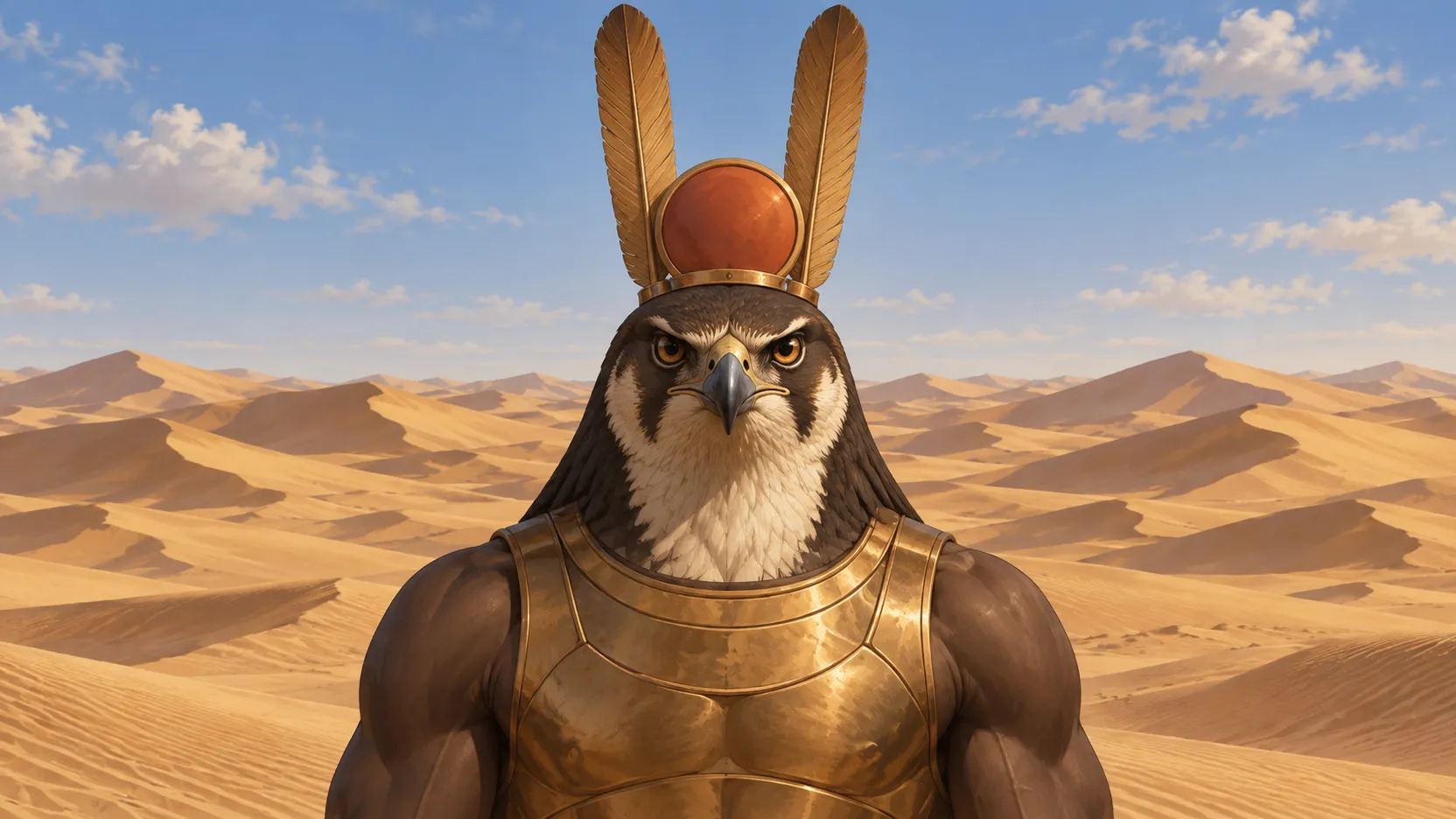
The Knife in the Sanctuary
The king put a knife into the bull keeper’s hand.
“Before they come through the gate.”
The keeper looked at the blade. His other hand rested against Buchis’s neck, where the hide rose and fell with each slow breath. Outside, something heavy struck wood. Dust sifted from the lintel.
“He must lower his head,” the keeper said. “He won’t do that for you.”
“Then make him do it for you.”
Montu heard them from the darkness of his sanctuary.
The king had come to this place before, carrying a bow he had broken against an enemy’s shield. He had laid it beneath the god’s falcon-headed image and promised a gate plated with metal when he returned victorious. Now he had returned without his bow. Blood had dried along one side of his crown. Behind him stood six men, and through the open doorway came the cries of many more, none of them cheering.
“They took the northern camp,” the king told the keeper. “They followed us here. If they lead this animal away, they will parade him before every town between Armant and the sea.”
The keeper’s fingers closed around the knife.
Montu stirred within the living bull.
Warmth gathered around him: the weight of the belly, the itch beneath the halter, the keeper’s familiar palm. The sanctuary narrowed into two dark doorposts and the bright courtyard beyond. He smelled the king’s sweat through the incense. He smelled river mud on the soldiers’ feet.
The keeper touched his forehead to the bull’s.
“I’m sorry,” he whispered.
The knife turned.
Montu flung up his head.
The tether snapped taut. Its ring tore from the wooden post, struck the wall, and fell ringing on the stones. The keeper stumbled back. Before the king could move, the bull’s horns caught him beneath the arms and lifted him against the door.
His crown hit the lintel.
“Put down the knife,” Montu said.
The sound came from deep inside the broad chest. The king went rigid against Montu’s horns.
The knife clattered. The keeper had already dropped it.
Montu lowered the king until his heels found stone.
“You asked me for victory.”
“I had an army then.”
A second blow shook the outer gate. One of the six men turned toward it. His shield shook so badly that its rim tapped against his spear.
“You still have men,” Montu said.
The king looked at them. One was scarcely standing; another had bound his forearm to the shaft of his weapon.
“There are boats at the landing.” His voice fell. “I can save these.”
Montu pushed past him. The torn length of tether dragged between his forelegs.
“Take up your shield.”
The Narrow Road
Refugees filled the courtyard, pressed between baskets, sleeping mats, and jars that no one would leave behind. A woman was trying to carry a child and a sack of grain. Each time she lifted one, she lost her grip on the other.
Beyond the courtyard stood the outer gate. One leaf hung crooked; the lower hinge had pulled free of the brickwork. Through the gap Montu saw the raised road leading toward the fields. Water lay along both sides of it. Near the gate it widened enough for carts to pass. Farther out, two men could barely walk abreast.
Enemy shields crowded that narrow strip. Behind them men carried a beam.
The bull keeper came after Montu with a rope looped over his shoulder.
“No,” Montu told him.
“The old tether is under your feet.”
He bent, caught the trailing cord, and cut it away with the king’s knife. Then he straightened and stared through the broken gate.
The beam struck again. A crack ran up the remaining hinge post.
Behind Montu, a soldier cried out that the boats were leaving.
The king had reached the passage to the landing. He stopped with one hand against the wall. Down that passage lay water and a way out. In front of him, the bull keeper was pushing a fallen basket clear of Montu’s feet.
The gate broke inward.
Montu charged.
The first shield burst against his forehead. He felt its rim slide along a horn, felt a man leave the ground and strike the road. The men with the beam dropped it. One went backward into the water; the others scrambled over him.
The road opened.
Montu drove on.
Ahead, the next rank did not run. Its leader knelt, braced his spear against the packed earth, and shouted. The men beside him lowered theirs. Montu saw the points come together. He tried to turn, but the road was too narrow for his weight.
One spear struck his shoulder.
Pain drove hot and sudden through the living flesh. His foreleg folded. He lurched against the bank, and a slab of earth dropped into the water beneath him.
The leader pulled his weapon free.
Montu backed away, head swinging. His blood darkened the dust. The spear points followed, advancing only when he yielded, stopping whenever he lowered his horns.
He could hear the keeper calling from behind him.
The man had followed to drag the broken gate leaf out of the passage. Now its upper edge had fallen across his ankle. He was on his back beside the doorway, pulling at the wood with both hands.
An enemy stepped past Montu’s flank toward him.
Montu swung his head. The man jumped back. The movement tore at the wounded shoulder, and for a moment the bull saw only white.
He could scatter a man with a touch. He could not face both ways.
The spears moved closer.
The King’s Standard
A shield slid across the stones and stopped against the keeper’s chest.
“Over your head!”
The keeper caught it. A spear struck the hide covering and glanced aside.
The king came through the gateway behind the shield. He had taken off his crown. A soldier followed him, then another. Together they heaved at the gate leaf, but the broken hinge was caught beneath a heap of brick.
Montu planted himself across the road.
The spear leader thrust. Montu caught the shaft between his horns and snapped it against the ground. Another point reached over the first man’s shoulder. He jerked aside; it scored his cheek.
Behind him the king grunted. Wood scraped stone.
The keeper screamed once, then slid free.
“Inside,” the king told him.
He thrust the man toward the soldiers. The keeper tried to put weight on his foot and nearly fell. Two men took his arms and carried him through the gate.
The king remained outside.
The soldiers returned from carrying the keeper. At his shout, they slipped into the gap beside Montu and locked their shields. The spear leader struck once, then stepped back to draw a second man alongside him.
Montu could see the king at the edge of his vision, breathing hard, holding the recovered shield. Above the doorway the royal standard hung from its pole. Its painted cloth snapped in the wind from the canal.
The king pulled it down.
He tore the cloth against the broken hinge and wound the strip around Montu’s shoulder, passing it under the chest. His hands were slippery. The first knot failed.
Montu stamped. The wound burned beneath the pressure.
“Hold still,” the king said.
A spear glanced off a defender’s shield and struck the one he had propped against the bull’s flank. The king flinched, pulled the knot tight, and took up the shield again.
Beyond him, the other soldiers had formed across the doorway. They could still retreat into the courtyard. They could still hold the narrow passage to the boats.
Montu could smell their fear. His own heart battered the wounded flesh. Every movement of the spear points drew his head downward, urging the charge that would reach them before another thrust reached him.
But the leader had planted a fresh spear. Behind him, a second man watched Montu’s eyes and waited to strike wherever he turned.
The king saw it too.
“If you go straight at them, they’ll set the points again.”
Montu shifted his weight onto his sound foreleg.
“Move them.”
The king looked at the narrow road. Then he looked at the shield in his hand.
He called two men forward. They came reluctantly, one limping, both watching the horns. He put them beside him at the widened mouth of the gate and showed them where to stand.
Montu waited behind their shields.
The enemy leader shouted an order. His front rank came forward, leaving the narrow neck of the road for the broader ground at the entrance. More men pressed behind them, eager now. They had seen the god bleed.
The king’s left-hand soldier took a step backward.
The king caught his shield rim.
“With me.”
The man stopped.
The Charge
The first spear struck the king’s shield hard enough to drive him onto one knee.
Montu surged forward, but the king shouted before he could pass.
“Wait!”
The word struck him more sharply than the spear had.
The king was down. The leader was drawing his arm back. Montu had room to charge now, a clear line past the fallen shield, and every part of the bull strained toward it.
Then he saw the second spear, held low beside the leader’s leg.
He dug his hooves into the earth.
The leader thrust again.
The king turned his shield across the shaft, trapping it against his shoulder. He rose with it, pushing upward. His two soldiers stepped in. One struck the lower spear aside; the other drove his shield into the man holding it.
For a breath, the points faced the sky.
The king threw himself toward the bank.
Montu charged through the space he left.
His wounded leg buckled on the second stride. He caught himself, drove from his hindquarters, and struck the center shield before the leader could wrench his spear free.
The impact ran through him from skull to tail.
Men collided behind the shield. The front rank folded into the next. On the narrow road there was no room to spread, no room to lower the long shafts. Montu drove forward with his head low, lifting, pushing, forcing the packed bodies backward. A spear scraped along his side and vanished beneath a fallen shield.
The king came up beside him.
This time the soldiers followed.
They struck at the men trying to turn their weapons. One seized a shaft with both hands and dragged its owner off balance. Another snatched up the fallen beam and shoved it against the shields. Montu felt the pressure lessen in front of him.
The enemy line broke at the narrow neck.
Men scrambled into the shallow water. Those behind them turned and ran toward the fields, trampling the reeds along the bank. Their leader tried to stand. Montu lowered a horn beneath his shield and flung it aside. The man rolled down the slope and disappeared among the others.
The bull took one more step.
His leg gave way.
The king caught the loose end of the binding, as though a strip of cloth could hold him up. He shouted for the beam. The soldiers brought it, and together they braced it beneath the bull’s chest until he could find his feet.
Beyond the broken shields, the raised road lay empty.
The king looked toward the fleeing men. His hand tightened on a spear someone had given him.
From the courtyard came the keeper’s voice.
“Bring him back.”
The king laid the spear down.
They returned slowly. At the doorway, soldiers were already lifting bricks into the gap. The boats had come back to the landing; wounded men were being carried down the passage, feet first, while the woman with the grain sack sat on it and held her sleeping child.
Buchis’s keeper waited on a low stool. He had set out a basin, but he could not rise to fill it.
The king took it from him.
When he returned, water spilled over the edge and darkened the dust on his feet. He knelt beside the bull and held the basin beneath the heavy muzzle.
Montu drank. The water tasted of clay, and each swallow moved against the tight bandage. The keeper rested his hand in the old place along the neck.
The basin emptied.
The king went back for more.