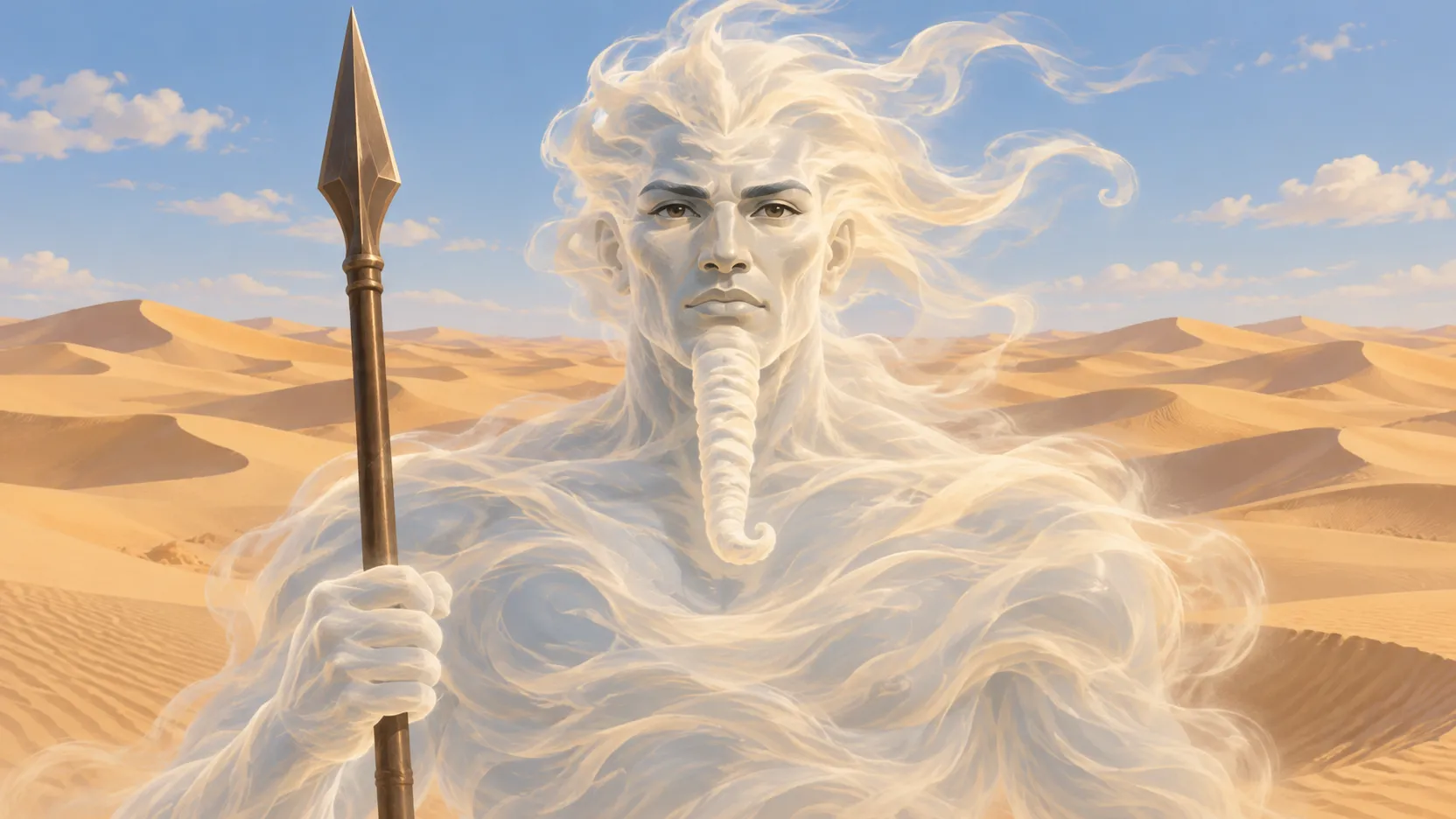
The lioness lay down before Anhur could tighten the rope.
He had expected a charge. He had planted his feet for it, with the line wrapped around his forearm and his spear braced against a stone. Instead, Mehit folded her forelegs beneath her breast and looked at the loop around her neck.
Behind Anhur, one of the boatmen laughed with relief.
Mehit turned her head toward the sound.
The man stopped laughing.
“Pull,” she told Anhur.
He took a step backward. The rope straightened. Mehit did not move.
Below them, the river ran between a shelf of dark rock and the far bank, where their boat waited. Beyond that bank lay the road north. Anhur had followed her tracks through the southern desert, past the bones of animals that had tried to share her shade. He had brought four men with a boat, provisions, and a line strong enough to hold her. Now the line was around her neck.
He pulled again.
Her shoulders rose. For an instant he thought she would follow. Then she came at him so quickly that the slack struck his legs.
Anhur lowered the spear.
Mehit stopped with its point between her eyes. Her breath ran hot over his knuckles. Behind him, sandals scraped on stone as the men fled toward the water.
“You have caught me,” she said. “Now bring me.”
He could drive the point forward. He had enough room. She knew it; he saw her glance at his hands.
He raised the spear.
“I came to take you home.”
“Then walk.”
He turned his back on her.
The first step cost more than the whole pursuit. At the second, he heard her rise. At the third, the rope dragged across the stone beside his heel.
The Passage North
They brought the boat across on poles, keeping close to the upstream shallows. Its broad, shallow hull had carried the men and their stores easily. With Mehit aboard, it rode lower. Water lapped at the seam beside the pilot’s ankle.
The younger boatman moved a basket toward the stern.
“Leave that,” the pilot said.
“She needs the room.”
“She has room.”
The boy set it down. Mehit watched him from the bow, her paws together, her tail lying along the gunwale. Anhur passed the rope twice around the mast and tied it. The remaining length lay coiled at his feet. He could reach Mehit in two strides, but she could not reach the men at the stern.
She tested the line once, gently.
Anhur checked the knot.
Across the water, a landing of packed earth showed pale above the reeds. The road continued from it toward Egypt. Anhur pictured the men waiting farther north, their spears raised in welcome; the temple court at Thinis; the story the boatmen would tell. He had brought back the distant goddess. Even now, looking at the tawny shoulders filling the bow, he could feel the weight of that return.
Mehit looked past him at the coil.
“Will you lead me through the town with that?”
“If I must.”
“And where will you tie it?”
He said nothing.
“To a doorpost? A pillar? Will you stand beside it all night?”
The pilot pushed them away from the rock. His pole slid through his hands, struck bottom, and bowed.
“Keep her forward,” he told Anhur. “If she moves, tell me.”
Mehit laid her chin on her paws.
The boat slid into the current.
For a little while there was only the scrape of poles and the wash along the hull. The younger boatman worked opposite the pilot. Each time he lifted his pole, he glanced at Mehit before setting it down again. She followed its dripping end with her eyes.
“Look at the water,” Anhur told him.
The boy nodded. His next stroke went deep.
The pilot called for him to lift.
He pulled. The pole would not come.
“Let it go!”
The boy held on one heartbeat too long. The current turned the boat around the trapped pole and flung his chest across the gunwale. Anhur caught his belt. The mast lurched against Anhur’s shoulder; somewhere beneath his feet, wood struck rock.
The sound was short and heavy.
The boy’s belt tore. Anhur seized a wrist and hauled his shoulders back inside.
Water was coming through the floor.
What the Rope Held
The pilot thrust his remaining pole over the side. It skidded across the submerged rock without finding purchase. The current pressed the hull sideways, driving the broken planks inward.
“Overboard,” Anhur said. “Upstream side. Onto the rock.”
Two men climbed out. Water struck their knees, then their thighs. They caught each other and stood on the narrow ridge just beneath the surface.
The pilot reached for the young boatman.
“I cannot,” the boy said.
His foot was beneath the crossbench. The collision had driven one end of it down through the splintered floor. He pulled at his knee with both hands.
Anhur pushed the spear shaft under the bench and bore down. The timber lifted a little. The boy cried out and tried to wrench free.
“Wait. When I tell you.”
Mehit rose.
The bow dipped. Water poured over it. She stepped backward toward Anhur, and the line stopped her beside the mast.
“Down,” he said.
Her ears flattened.
He pushed harder on the spear. A crack traveled up the shaft.
The pilot wedged his own pole beneath the bench beside it. Together they lifted the timber far enough for the boy to drag his foot out. He fell backward into the water inside the hull.
Anhur caught him beneath the arms. The boy’s leg hung at an angle it should not have made. The pilot dragged his pole free, leaving the spear wedged under the timber.
On the rock, one of the men shouted. The boat had begun to roll toward them. They scrambled away, and the downstream man lost his footing. His companion caught him by the shoulder, but both were sinking off the ridge.
The pilot grabbed the coiled rope.
Anhur seized his wrist.
For a moment neither moved. The pilot looked at Anhur’s hand, then at the knot around the mast.
Anhur looked from the loose coil to the bank. It would fall short. They needed the whole line: the turns around the mast, the taut length reaching to Mehit’s neck. With all of it, they could reach the bank and give the men something to hold while they worked along the shallows. One end would have to be fastened to the boat; somebody would have to carry the other ashore.
The lioness stood between them and the long, clear stretch of line.
Mehit looked toward the bank. Then she looked at Anhur.
He saw the whole journey returning to nothing: the emptied water skins, the tracks lost and found again, the moment the loop had fallen over her head. If she went south now, he would be left with four wet men and a broken boat. The town would hear how he had caught her, and how he had failed to bring her back.
The man on the rock slipped lower. His mouth went under.
Anhur let go of the pilot.
He stepped through the rising water and drew the small knife from his belt. Mehit lowered her head toward him. He could see where the rope had pressed the hair flat beneath her jaw.
He cut it there.
She sprang past him before he had lowered the knife. Her hind paws struck the gunwale. The boat tilted, and Anhur fell against the mast.
Mehit landed on the rock beyond the two struggling men, crossed it in three bounds, and plunged toward the bank.
“Go,” Anhur told the pilot.
He freed the rope from the mast, thrust its end into the pilot’s hands, and lashed the other end around the heavy bow beam. The pilot climbed over the side and followed the ridge, passing the line to the men as he went. They got their arms over it. One coughed water into the current.
The bow beam groaned.
Anhur lifted the injured boy and carried him to it. Behind them, the bench shifted. The spear snapped beneath it, and the broken stern swung away.
The Far Bank
The rope tightened.
Anhur saw the pilot reach the shallows. Beyond him, the bare bank rose too steeply to climb one-handed. He tried to drive his pole into the mud, but it slipped. The men farther out clung to the line, dragging him backward each time the current struck them.
Mehit stood above him on dry earth.
She shook the water from her coat.
The pilot looked up. His hand opened on the rope.
“Hold it!” Anhur shouted.
The pilot closed his fist again. He leaned into the bank, trembling with the effort, while Mehit came down toward him.
Anhur shifted the boy higher against his chest. There was no spear left. Nothing he could throw. If Mehit chose to strike, the pilot could neither flee nor defend himself.
She opened her jaws.
The pilot shut his eyes.
Mehit took the rope above his hand.
She climbed backward up the bank, drawing it taut. The pilot fell forward onto his knees in the mud. He crawled after her, found the exposed root of a tree, and wound the free end around it. Mehit kept her grip until he had made the knot.
Then she released it.
The men worked toward shore, one behind the other. Anhur waited until both were past the broken hull. He stepped into the river with the boy pressed against his shoulder and one hand on the rope.
The water took his feet from under him.
He held on. The boy’s head struck his chin; he lifted it clear. Behind them, the bow tore loose from the rock. Its weight came down the rope, wrenching Anhur’s arm straight.
At the bank, the root began to rise out of the earth.
The pilot threw himself over it. Mehit caught the line again, paws digging furrows in the slope.
Anhur moved one hand forward. Then another. The boy had both arms around his neck now. Each time Anhur dipped, the grip tightened.
He could not tell him to loosen it. He needed his breath.
The bow beam struck a rock downstream. For an instant the pull eased. Anhur took two steps, found gravel beneath one foot, and drove upward.
The pilot reached him first. Together they dragged the boy out and laid him above the wash.
Anhur stayed on his knees until the boy coughed.
Beside him, Mehit spat out the rope. A little blood marked the wet fibers.
He reached toward her mouth. She drew her head away.
“The boat,” she said.
The root was still coming loose.
Anhur cut the line below the knot. The wreck turned once in the current and went downriver, carrying his broken spear with it.
For a while they watched it go.
Then the pilot began tearing linen for the boy’s leg. Anhur found two straight pieces of driftwood. Mehit lay nearby as they bound the splints, close enough that the boy could see her whenever he opened his eyes.
“You could have gone,” Anhur said.
She looked at the wet rope beside his knee.
“So could you.”
Through the Gate
They took the road north, resting in the hottest hours and walking again when the stones cooled. At the first town in Egypt, the boy was still on Anhur’s back.
He had carried him since the landing. The others followed with what little they had saved. Mehit walked beside them, sometimes leaving the road to smell the ground, sometimes drawing so close that her shoulder brushed Anhur’s leg.
At the gate, a man lifted his spear across the opening.
Anhur stopped.
The man looked from the lioness to the god’s empty hand. Then he saw the splinted leg hanging beneath Anhur’s arm.
“Make room,” Anhur said.
The spear rose. Someone ran for a pallet. People came out of the houses, calling to one another, and the road filled with feet.
Mehit waited at the gate.
Anhur lowered the boy onto the pallet and turned back. The pilot stood beside her with the salvaged rope looped over his shoulder. He started to take it down.
“Keep that,” Anhur told him. “You will need it for your next boat.”
Mehit stepped through the opening. Anhur went beside her, matching his pace to hers, while behind them the pilot began to unpick the wet knots.